

Uncategorized
Brazilian Jurema vs. Mexican Tepezcohuite: Which MHRB Origin Is Right for Your Project?

While both hail from the exact same botanical species—Mimosa tenuiflora (syn. Mimosa hostilis)—experienced natural dyers, soapmakers, and botanical artisans know that geography matters.
Root bark harvested from the semi-arid Caatinga of northeastern Brazil (Jurema Preta) develops under different soil minerality, drought stress, and sun exposure than bark collected from the limestone-rich valleys of southern Mexico (Tepezcohuite). These terroir differences create distinct tannin densities, fibre textures, and chromatic palettes.
1. Quick Comparison: Brazilian vs. Mexican MHRB
| Feature | Brazilian Origin (Jurema Preta) | Mexican Origin (Tepezcohuite) |
| Native Region | Bahia, Pernambuco, Ceará (Caatinga scrub) | Chiapas, Oaxaca (semi-arid valleys) |
| Traditional Name | Jurema Preta / Vinho da Jurema | Tepezcohuite / “Skin Tree” |
| Dominant Colour Tone | Cool tones: plum, aubergine, deep slate-violet | Warm tones: terracotta, brick-red, ruby-crimson |
| Fibre Consistency | Dense, curlier, highly compact root bark | Straight, long, stringy fibrous ribbons |
| Tannin Saturation | 17%–21% condensed tannins (very heavy) | 15%–19% condensed tannins (balanced) |
| Soap & Topical Feel | High astringency, earthy cocoa marble swirls | High triterpenoid saponins, rich red marble swirls |
| Best Application | Deep purples, leather tanning, dark wood stains | Vibrant berry reds, cosmetic soaps, botanical salves |
2. Colour Profiles & Dye Swatch Comparisons
The primary reason artisans debate Brazilian vs. Mexican MHRB is the chromatic direction of the dye bath. Condensed tannins and polyphenols bond differently based on soil pH and regional flavonoid concentrations.
Natural Dye Results on Wool & Silk (Protein Fibres)
- Mexican Tepezcohuite:
- Standard Alum Bath (pH 6.0–6.5): Vibrant brick-red, burnt terracotta, and warm mahogany.
- Acidic Shift (pH 4.5 with vinegar/citric acid): Pushes the hue toward bright ruby-crimson and fiery rust.
- Iron Post-Bath (1% ferrous sulphate): Shifts into a rich, dark espresso brown with warm undertones.
- Brazilian Jurema Preta:
- Standard Alum Bath (pH 6.0–6.5): Deep wine-red, mulled berry, and dusty plum.
- Alkaline Shift (pH 8.0–8.5 with soda ash): Dramatic shift toward cool aubergine, violet-purple, and slate-blackberry.
- Iron Post-Bath (1% ferrous sulphate): Yields dark charcoal-black and deep midnight violet.
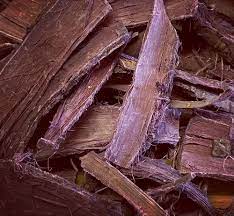
3. Physical Fibre Structure & Workshop Handling
When handling raw or shredded bark in the studio, the two origins handle differently during extraction and straining:
Mexican MHRB (Fibrous & Ribbon-Like)
- Structure: The root cambium from Mexican trees tends to pull away in long, pliable, stringy ribbons.
- Extraction: Water flows freely through the fibres. When simmering, it rarely clumps or creates dense dead zones in the pot.
- Filtration: One of the cleanest barks to strain. Running it through a standard colander or pasta strainer separates 99% of the material in a single pass.
Brazilian MHRB (Dense & Compact)
- Structure: Due to slower growth in hyper-arid Caatinga scrub, Brazilian inner bark is thicker, curlier, and more brittle.
- Extraction: Extremely dense tissue that benefits greatly from a 24-hour pre-soak to soften cell walls before simmering.
- Tannin Yield: Delivers a heavier initial tannin wash, which makes it popular for vegetable leather tanning where grain tightening and density are paramount.
4. Soapmaking & Cosmetic Applications
If you are crafting natural skincare or cold-process soaps:
- Choose Mexican Tepezcohuite for Facial Balms & Soaps: Mexico has centuries of documented ethnobotanical skincare based on Tepezcohuite (celebrated for its triterpenoid saponins, mimonosides, which promote skin regeneration). Its micro-milled powder disperses with a warm, clay-pink to rich mahogany tone that looks appealing in bar soaps.
- Choose Brazilian Jurema for Heavy-Duty Astringent Bars: Brazilian bark has an exceptionally dense tannin profile. In body soaps, it imparts stronger natural astringency, making it popular for clarifying bars designed for oily or blemish-prone skin.
5. Which Origin Should You Choose?
Choose Mexican MHRB If:
- Your project demands warm reds, fiery terracotta, or bright crimson tones.
- You are formulating Tepezcohuite skincare, facial clays, or healing salves.
- You want shredded bark that strains quickly and cleans up with minimal mess.
Choose Brazilian MHRB If:
- You are targeting cool purples, plum, deep aubergine, or dark slate hues.
- You are tanning thick leather hides that need maximum condensed tannin concentration.
- You want an authentic botanical specimen tied to the historic traditions of northeastern Brazil (Jurema Preta).
Frequently Asked Questions (FAQ)
Is one origin stronger or higher quality than the other?
No. When working with verified 100% inner root bark (cambium) free of outer cork and wood core, both Mexican and Brazilian varieties are top-tier botanicals. Quality depends entirely on harvest maturity and proper inner-bark separation, not geographic superiority.
Can I mix Brazilian and Mexican bark in the same dye pot?
Yes. Blending 50% Mexican with 50% Brazilian MHRB produces a balanced, complex burgundy-wine hue that bridges warm brick undertones and cool violet shades.
Do both origins contain the same active compounds?
Yes. Both belong to Mimosa tenuiflora and share the same core chemical footprint: condensed tannins, triterpenoid saponins, flavonoids, and naturally occurring indole alkaloids.
Summary
Neither origin is objectively “better”—they simply provide different artistic palettes. If you want warm terracotta and vibrant red dyes or traditional Tepezcohuite skincare, go with Mexican origin. If your goal is deep purple and slate-toned textiles or heavy-duty leather tanning, choose Brazilian origin.
