

Uncategorized
Inner Bark vs. Outer Bark: 5 Signs of Authentic, High-Grade Mimosa Hostilis

Looking to buy Mimosa Hostilis Root Bark Powder in Europe or internationally?
Our ethically harvested, lab-tested Mimosa tenuiflora – also known as Jurema Preta – delivers exceptional purity, potency, and consistency.
Sustainably sourced from the Brazilian highlands, our MHRB powder is ideal for natural dyeing, skincare formulations, research projects, and traditional applications.
What Is Mimosa Hostilis Root Bark Powder?
Mimosa Hostilis (also called Acacia hostilis, Jurema Preta, Calumbi) is a tropical leguminous shrub native to northeastern Brazil and parts of Mexico.
Its inner root bark is rich in tannins and bioactive compounds, making it valuable for:
🌱 Natural textile dyeing (deep purples and reds)
🧴 Topical skincare preparations supporting skin health
📚 Ethnobotanical and traditional uses
🔬 Scientific and cosmetic research
Why Choose Our MHRB Powder?
We are one of Europe’s most trusted suppliers of Brazilian Mimosa Hostilis root bark – sustainably harvested and processed under strict, chemical-free conditions.
✅ Sustainable Harvesting
Only one root per tree is harvested to protect the plant’s survival.
We never cut down entire trees for bark extraction.
✅ 100% Natural Processing
Collected during the rainy season on pesticide-free land.
No fertilizers or chemical sprays – natural pest control through seasonal cycles.
Carefully cleaned, shade-dried, and ground into fine powder with sterile equipment.
✅ Higher Potency & Purity
Fiber content is removed, resulting in a 30% more concentrated product.
Composed of 130% pure inner bark compared to many unfiltered alternatives.
✅ Maximum Freshness
Harvested in small batches several times per week.
Processed fresh to preserve full potency of active compounds.
Product Details
Name: Mimosa Hostilis Root Bark Powder (MHRB)
Botanical Name: Mimosa tenuiflora
Common Names: Jurema Preta, Calumbi, Tepescohuite, Carbonal
Origin: Northeastern Brazil
Available Forms: Micronized powder, shredded bark, whole pieces
Purity: 100% natural – no additives or chemicals
Packaging: Airtight, food-grade pouches for long-lasting freshness
Benefits & Traditional Uses
🌿 Natural Wound Healing: Traditionally used in Brazil & Mexico for burns, ulcers, and cuts.
🧴 Skin Regeneration: Supports tissue repair and helps reduce inflammation.
🦠 Antimicrobial Effects: Shows resistance against bacteria and fungi in studies.
🎨 Textile Dyeing: Favored by eco-fashion brands for its deep, lasting pigments.
Who Uses Our MHRB Powder?
Textile and natural dye artists
Herbalists and naturopathic practitioners
Cosmetic formulators and skincare brands
Research institutions and universities
Ethnobotanical collectors
Fast EU & Worldwide Shipping
We offer quick, secure, and discreet shipping across Europe and worldwide.
Orders shipped within 24–48 hours
Customs-friendly packaging for smooth delivery
Special wholesale and research pricing available
👉 Order premium Mimosa Hostilis Root Bark Powder today – trusted by researchers, artisans, and wellness brands across Europe. Bulk quantities available on request.
Frequently Asked Questions (FAQ)
1. What makes your MHRB powder better than others?
Our powder is freshly harvested, triple-cleaned, fiber-filtered, and completely chemical-free – making it up to 30% more concentrated than standard root bark powders.
2. Is Mimosa Hostilis legal in Europe?
In most European countries, Mimosa Hostilis is legal for uses such as dyeing, skincare, and research. Please check local regulations before purchasing.
3. Can I use it for natural soap or skincare products?
Yes! Many customers use our MHRB powder for natural soaps, balms, and skin-healing formulations.
4. Is it the same as Jurema Preta?
Yes, Jurema Preta is a common name for Mimosa tenuiflora and refers to the same plant.
Due to surging global demand for natural dyes and Tepezcohuite cosmetics, low-grade and counterfeit Mimosa hostilis root bark (MHRB) is common in the botanical supply chain. Unscrupulous suppliers frequently pad their shipments by milling inactive grey outer cork, passing off aerial trunk bark as root bark, adding neutral wood sawdust, or reselling “spent” bark that has already been boiled for tannin extraction.

Knowing how to visually and chemically verify raw botanical material ensures you receive pure, active inner root bark (Mimosa tenuiflora) capable of rich pigment yield and reliable performance.
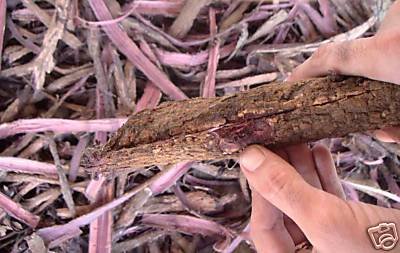
1. The Anatomy of MHRB: Inner Cambium vs. Outer Cork
Understanding tree anatomy is the foundation of quality assessment. An authentic harvest strips the root into distinct anatomical layers:
- Outer Cork Bark (Periderm): The rough, weather-exposed outer layer of the root. It is dull grey, beige, or ash-brown, fibrous, and largely inert. It contains virtually no condensed tannins or active flavonoids.
- Inner Root Cambium (The “Gold Standard”): The living vascular layer directly between the outer cork and the inner xylem (wood core). It possesses a saturated violet, wine-red, or deep maroon hue and concentrates 16% to 20% of the plant’s condensed tannins.
- Woody Core (Xylem): The pale yellowish-white structural wood at the center of the root. It contains zero useful pigment and should never be present in premium batches.
The Scam: Low-grade suppliers grind the entire root—cork, wood core, and inner cambium together—or harvest above-ground tree trunks. This dilutes the active cambium content down to 20%–30%, yielding weak, muddy brown dye baths.
2. The 5 Signs of Authentic, High-Grade MHRB
| Authentication Marker | Premium Inner Root Bark (High Grade) | Low-Grade / Adulterated Material |
| 1. Coloration (Dry) | Deep magenta, rich violet-red, or dark purple-brown | Pale tan, sandy beige, dull grey, or yellowish-brown |
| 2. Aroma | Earthy, sweet, black-tea, and dried leather profile | Musty, dusty, cardboard-like, or sour/mildewed |
| 3. Texture & Consistency | Dense, fibrous strings (shredded) or silky, flour-like dust (powder) | Sandy, gritty, splintery chunks of yellow wood |
| 4. Cold Water Dispersion | Water turns deep pink/amber-red within 5 minutes | Water turns faint yellow, muddy brown, or remains clear |
| 5. Extraction Residue | High dye exhaustion; leaves deep purple stain | Leaves excessive fibrous mulch with weak, pale runoff |
3. How to Inspect Different Cuts
Whole Bark Slabs
- What to look for: Inspect the cross-section. The outer side may have subtle traces of dark red-brown skin, but the underside must be a uniform, deep reddish-purple.
- Red Flags: A thick, crumbly layer of grey bark on the outside or a pale, creamy-white core indicates the bark was taken from the main trunk or improperly debarked.
Shredded Ribbons
- What to look for: Coarse, stringy ribbons with visible vascular grain. The fibres should range from deep crimson to dark maroon.
- Red Flags: Noticeable quantities of light yellow or white woody splinters. This confirms the supplier chipped the woody core of the tree to artificially increase weight.
Finely Milled Powder
- What to look for: A homogenous, micro-milled powder (<100 mesh) that displays an unmistakable reddish-purple or deep cocoa-violet tint. When compressed with a spoon, it should feel velvety.
- Red Flags: A gritty, cinnamon-brown or sandy-tan powder. If it looks like baking cocoa mixed with sand, it contains high amounts of trunk cork or filler sawdust.
4. The 3-Minute Kitchen Water Test
If you receive a batch of powder and want to test its authenticity before committing to a dye bath or cosmetic recipe, run this simple cold-water extraction test:
1.Measure the Sample:
Take 1 teaspoon (approx. 3 g) of your MHRB powder or shredded bark.
2.Introduce Cold Water:
Add the sample to a clear glass filled with 150 ml of room-temperature tap water. Do not heat the water.
3.Observe Color Bleed:
Stir briefly for 10 seconds and let it settle. Authentic high-tannin inner cambium will immediately begin bleeding deep reddish-amber and violet swirls into the water within 60 to 120 seconds.
4.Evaluate Sediment:
After 5 minutes, observe the liquid: pure inner bark creates a rich, translucent ruby-red liquor. If the liquid remains pale yellow while a heavy, greyish-tan silt settles at the bottom, the batch is heavily cut with outer trunk bark or wood filler.
5. Identifying “Spent” or Depleted Bark
Another deceptive practice in secondary markets is the resale of “spent” bark—material that has already undergone industrial extraction for tannins or active alkaloids, dried out, and repackaged.
- Scentless Profile: Spent bark loses its distinctive tea-and-leather aroma, smelling flat, sterile, or like wet cardboard.
- Brittle, Ashy Appearance: Depleted bark looks dull and faded, often taking on a washed-out, greyish-maroon hue rather than an oily, vibrant sheen.
- Zero Cold Bleed: When subjected to the cold water test, spent bark yields little to no pigment because its water-soluble tannins and flavonoids were already extracted during its first use.
6. Sourcing Checklist: Questions to Ask Your Supplier
Before purchasing bulk botanical quantities online, verify the vendor’s sourcing standards:
- “Is this 100% inner root bark, or whole root?” Premium vendors specify inner root bark (cambium only). If they answer “whole root,” expect 40%–50% inactive wood and cork.
- “Is this root bark or trunk bark?” Trunk bark (Tepezcohuite de tronco) is significantly cheaper to harvest because it doesn’t require excavating roots, but it has inferior pigment density.
- “Where is the botanical harvested?” Authentic MHRB comes from native habitats: the Caatinga region of Brazil (Jurema Preta) or Chiapas/Oaxaca in Mexico (Tepezcohuite).
- “Is it packed in light-blocking barrier pouches?” Clear plastic bags expose the bark to ambient UV light, which degrades red flavonoids into dull browns before the package even arrives.
Frequently Asked Questions (FAQ)
Can high-quality MHRB powder look brownish instead of purple?
Yes, slightly. Mexican Tepezcohuite naturally leans toward a warmer reddish-brown or terracotta-burgundy, whereas Brazilian Jurema Preta leans toward a cooler, darker plum-violet. However, neither should ever look like light tan sand or light cinnamon.
Why does my shredded bark have a little bit of grey on one side?
It is normal for artisan-stripped bark to have minor traces of outer periderm adhering to the exterior face. However, this should account for less than 5% of the total piece. If half the thickness of the bark slab is grey cork, the debarking process was done poorly.
Does high-grade MHRB produce a sticky residue?
Yes. When boiled into a concentrated dye bath, the dense concentration of condensed tannins and natural plant sugars gives the hot liquid a slightly viscous, astringent feel between your fingers.
Summary
High-quality Mimosa hostilis inner root bark is defined by its deep purple-red coloration, rich earthy tea aroma, and rapid cold-water pigment release. By steering clear of pale, sandy powders and inspecting whole bark for clean separation from grey outer cork, you ensure your natural textile dyes and artisan skincare products perform with maximum potency.
